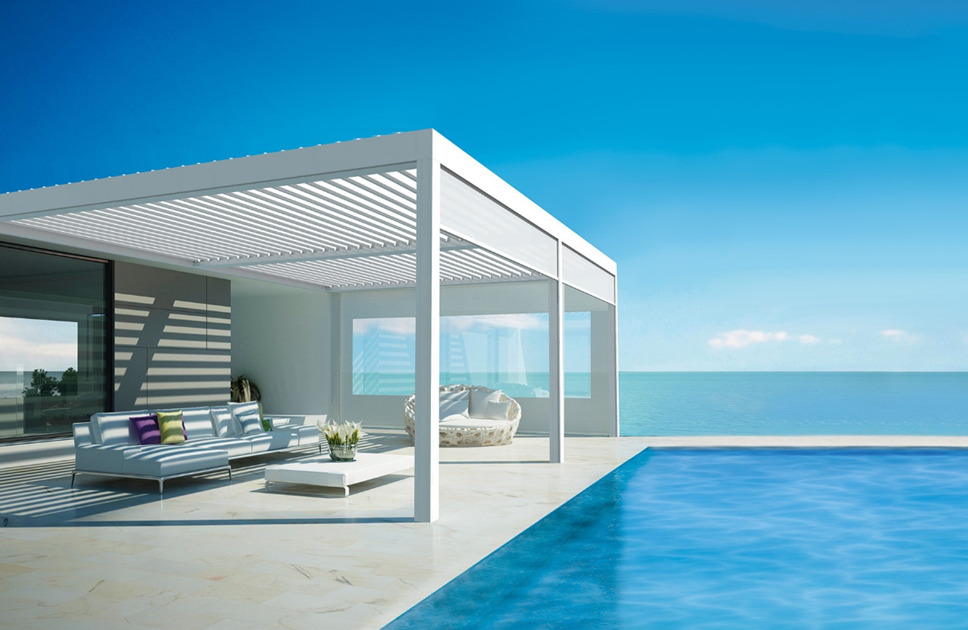
Bioclimatic (louvered) and retractable fabric pergolas solve a similar task — they create a comfortable terrace space and protect it from the sun and precipitation. However, their operating principle, roof design, ventilation capabilities, and use cases are different.
A retractable fabric pergola has a sliding roof made of reinforced PVC fabric. The fabric moves along guide rails, so the roof can be opened completely or stopped at any intermediate position — from maximum sunlight and fresh air to full protection from heat and rain.
A bioclimatic pergola is equipped with rotating aluminium louvers. By changing their angle, you can regulate the amount of light, shade, and natural ventilation without opening the roof completely. In rotating and retractable models, the louvers can also slide to the side, completely opening the space above the terrace.
There is no single option that is always better. A retractable fabric pergola is usually more suitable when you want to open the roof completely or cover large terraces. A bioclimatic pergola is better suited for precise microclimate control, modern architecture, and using the space throughout most of the year.
In short: which option should you choose?
A retractable fabric pergola is suitable if you:
-
want to open the roof completely and see the sky above the terrace;
-
mainly use the terrace during the warmer months;
-
want more options for the shape of the structure — a flat horizontal or arched roof, timber cladding, or cable-supported installation without floor-mounted supports.
A bioclimatic pergola is suitable if you:
-
want to control light, shade, and ventilation smoothly and quickly without opening the roof completely (the louvers rotate faster than the fabric roof retracts);
-
want a rigid aluminium roof that does not require replacement and can better withstand wind and snow loads;
-
plan to add glazing or heating so that the space can be used for most of the year;
-
see the terrace as a full extension of a home, restaurant, cafe, or other commercial space.
What is the main difference between a retractable fabric pergola and a bioclimatic pergola?
The main difference is the roof construction.
In a retractable fabric pergola, the roof consists of a continuous reinforced PVC fabric fixed to cross beams. When the roof is opened, the fabric moves along guide rails and folds into neat pleats.
In a bioclimatic pergola, the roof is made of aluminium louvers. They rotate automatically around their axis, changing the level of shade and ventilation. In the closed position, the louvers interlock to form a protective roof.
|
Criterion
|
Retractable fabric pergola
|
Bioclimatic pergola
|
|
Roof material
|
Reinforced PVC
|
Aluminium louvers
|
|
Opening mechanism
|
The roof retracts
|
The louvers rotate
|
|
Full roof opening
|
Yes
|
No, except for rotating and retractable models
|
|
Shade control
|
By opening or closing the roof
|
Precise adjustment of the louver angle
|
|
Natural ventilation
|
By partially or fully opening the roof
|
Through the gaps between angled louvers
|
|
Rain protection
|
Continuous PVC fabric
|
Closed aluminium louvers
|
|
Visual style
|
Lightweight, fabric-based
|
Architectural, high-tech
|
|
Large areas
|
Convenient modular expansion
|
Depends on the model and louver size
|
|
Main use case
|
Open or close the roof
|
Control light, shade, and airflow
|
How does a retractable fabric pergola work?
A retractable fabric pergola has a movable roof made from a continuous reinforced PVC fabric. The fabric is fixed to cross beams and moves along aluminium guide rails.
When opened, the roof folds into the upper section of the structure. As a result, the terrace remains almost completely open.
In the closed position, the fabric is tensioned to form a continuous roof. Because there are no joints between separate roof sections, the risk of leakage at the beam connections is reduced.
In M-OCEAN systems, the fabric is secured using an omega profile. It provides tension not only along the length but also across the width of the pergola, helping maintain the correct roof geometry and water drainage direction.
Protection from precipitation
In retractable fabric systems, water flows down the sloped PVC roof into the integrated front gutter. From there, it is channelled through internal drainage channels inside the posts to the base of the structure.
A leaf guard mesh can be used to protect the drainage system from leaves and debris.
The structure may also include side seals that reduce the risk of water entering along the edge of the fabric during wind-driven rain.
Automatic control
The retractable roof can be operated using an electric motor. M-OCEAN systems are compatible with Somfy automation, which, depending on the configuration, can control a substantial roof area.
The system can also include:
How does a bioclimatic pergola work?
A bioclimatic pergola has a roof made of rotating aluminium louvers.
When the louvers are opened at an angle, sunlight partially reaches the terrace while warm air escapes through the gaps between them. This creates natural ventilation without the need to open the roof completely.
When the louvers are closed, they form a solid protective roof. Water is directed across the surface of the louvers into the perimeter gutter and then drained through the posts.
In the M-OCEAN LINE bioclimatic system, the louvers can rotate from 0 to 150°. This allows the roof position to be adjusted according to the sun, temperature, and desired level of natural light. In the M-OCEAN LINE MOVE rotating and retractable model, the louvers rotate within a range of 0–110° and can also slide to the side, completely opening the space above the terrace.
Louver sealing
An EPDM seal is used to seal the joints between the louvers. It helps to:
-
reduce water penetration;
-
make the louvers close more quietly;
-
prevent direct contact between aluminium elements;
-
improve the watertightness of the roof.
The special shape of the louver profile directs water into the gutter and reduces the risk of precipitation accumulating on the roof surface.
Bioclimatic pergola automation
The louvers are rotated by an electric motor. M-OCEAN LINE systems use Somfy or Elero automation — with weather sensors, timers, and remote control.
The system can also include:

Which pergola provides better sun protection: a retractable fabric or bioclimatic pergola?
Both types of pergolas provide effective sun protection, but they work in different ways.
A retractable fabric pergola creates complete shade when the PVC roof is fully closed. This is convenient for terraces where the entire area needs to be quickly protected from direct sunlight.
A bioclimatic pergola allows the level of shade to be adjusted gradually. The louvers can be positioned at an angle that blocks direct sunlight while still allowing some natural daylight to enter.
|
Requirement
|
Best option
|
|
Fully protect the terrace from the sun
|
Retractable fabric or bioclimatic
|
|
Precisely control the amount of light
|
Bioclimatic
|
|
Open the roof completely
|
Retractable fabric
|
|
Maintain natural daylight without direct sunlight
|
Bioclimatic
|
|
Create complete shade over a large area
|
Retractable fabric
|
For south- and west-facing terraces, bioclimatic louvers are convenient because their angle can be adjusted throughout the day. A retractable fabric system works better when the preferred modes are «fully open» or «fully closed».
Which pergola provides better protection from rain?
A retractable fabric pergola has a continuous PVC roof, so with the correct tension, slope, and drainage system, it provides effective protection during heavy rain.
A bioclimatic pergola also provides protection from rain when the louvers are fully closed. Water flows across their surface into the integrated gutter.
However, watertightness depends on more than just the type of roof. Important factors include:
|
Criterion
|
Retractable fabric pergola
|
Bioclimatic pergola
|
|
Roof type
|
Continuous PVC fabric
|
System of individual louvers
|
|
Water drainage
|
Roof slope, gutter, posts
|
Louvers, perimeter gutter, posts
|
|
Protection during heavy rain
|
High with the correct configuration
|
High with the louvers closed
|
|
Maintenance requirements
|
Cleaning the fabric, gutters, and guide rails
|
Cleaning the louvers, gutters, and mechanisms
|
For open commercial terraces, it is important not only to choose the right type of pergola but also to calculate the drainage system correctly, taking into account the roof area and rainfall intensity.
Which pergola performs better in windy conditions?
Wind resistance depends on the specific model, dimensions, number of posts, anchoring method, and roof position.
Some M-OCEAN models can withstand wind loads of up to 8–10 on the Beaufort scale, while M-OCEAN LINE bioclimatic models can withstand up to 10. However, the actual wind resistance is determined by an individual engineering calculation.
When assessing wind resistance, the following factors are taken into account:
-
foundation type;
-
method of attachment to the facade;
-
exposure of the site;
-
location on upper floors;
-
presence of side screens;
Side enclosures increase comfort, but they also increase the overall wind load on the frame. Therefore, ZIP screens, glazing, or doors should be taken into account at the design stage.
Which pergola is better for ventilation?
A bioclimatic pergola has an advantage when it comes to precise airflow control.
Warm air rises and escapes through the gaps between the tilted louvers. At the same time, the roof can remain partially closed to block direct sunlight.
In a retractable fabric pergola, ventilation is controlled by the degree to which the roof is opened. If the roof is opened completely, airflow will be maximised. However, with the PVC fabric partially or fully closed, natural ventilation through the roof is less flexible.
|
Scenario
|
Best option
|
|
Continuous and precise airflow adjustment
|
Bioclimatic
|
|
Open the space as much as possible
|
Retractable fabric
|
|
Maintain shade while allowing hot air to escape
|
Bioclimatic
|
|
Create the feeling of a completely open terrace
|
Retractable fabric
|
Which pergola is better for large terraces?
For large areas, a modular retractable fabric system is often more practical.
For example, certain M-OCEAN configurations can offer:
-
a width of up to 13 metres;
-
multiple modules;
-
a projection of up to 7 metres;
-
an even greater projection in reinforced versions;
-
automatic control of a large roof area.
The reinforced M-OCEAN JUMBO system is designed for deep terraces and can provide a projection of up to 9.5 metres without intermediate supports in a standard configuration.
Bioclimatic pergolas can also be modular, but the maximum size of a single module depends on the length of the louvers, profile cross-sections, number of supports, and calculated structural load.
For a large restaurant or hotel terrace, the choice should be based not only on the type of roof but also on the possibility of:
-
modular expansion;
-
zoning the space;
-
covering a large projection;
-
installing intermediate posts;
-
draining a large volume of water.
Which pergola is better for a private home?
Both options are suitable for private homes.
A retractable fabric pergola is practical if the owners want to:
-
open the roof completely;
-
see the sky above the terrace;
-
have a visually lighter structure;
-
use the terrace mainly during the warmer months;
A louvered system is a better choice if:
-
precise light control is required;
-
heating and side enclosures are planned;
-
the space will be used for most of the year.
For homes with panoramic windows, it is also important to consider how much the pergola roof will shade the interior. In this case, rotating and retractable louvers or a retractable fabric roof that can be completely folded away can be considered.
Which pergola is better for a restaurant or hotel?
For a restaurant or hotel, the choice depends on the business model of the terrace.
A retractable fabric pergola is better if:
-
the pergola needs to shade a large area without additional supports;
-
the terrace will only be used during the spring and summer season;
-
it is important to maintain the feeling of an open summer space;
-
branding or decorative customisation is required.
A bioclimatic pergola is better if:
-
the terrace is positioned as a premium space;
-
extended seasonal use is required;
-
the microclimate needs to be controlled without fully opening the roof;
-
heaters, lighting, or glazing are planned;
|
Property type
|
Most suitable option
|
|
Seasonal cafe
|
Retractable fabric
|
|
Large restaurant terrace
|
Modular retractable fabric or combined system
|
|
Premium restaurant
|
Bioclimatic
|
|
Hotel with a large terrace
|
Reinforced retractable fabric or bioclimatic
|
|
SPA complex
|
Bioclimatic
|
|
Resort property
|
Depends on the area, wind conditions, and architectural style
|
Which option is better in terms of design?
A retractable fabric pergola has a lighter and softer appearance thanks to its fabric roof. It is well suited to:
-
Mediterranean architecture;
-
restaurants and outdoor dining areas;
-
country houses;
-
poolside areas;
-
properties that incorporate textile elements into their design.
A bioclimatic pergola has a more technological and solid architectural appearance. It works particularly well with:
The overall appearance is also influenced by the RAL colour, profile shape, type of posts, integrated lighting, and the method used to enclose the openings.
Which system is easier to maintain?
Both types of pergolas require regular maintenance.
A retractable fabric pergola requires:
-
cleaning the PVC fabric;
-
checking the fabric tension;
-
cleaning the gutters;
-
inspecting the rollers and belt;
-
checking the electric motor;
-
cleaning the guide rails;
-
checking the side seals.
A bioclimatic pergola requires:
-
cleaning the surface of the louvers;
-
removing leaves from the gutters;
-
checking the seals;
-
inspecting hinges and drive mechanisms;
-
cleaning the louver connection areas;
-
checking the automation system;
-
checking the drainage channels.
Which lasts longer: a PVC roof or aluminium louvers?
Aluminium louvers generally have a longer potential service life as a roofing material. They do not stretch, are less susceptible to UV exposure than textile materials, and retain their shape over a long period of time.
However, modern reinforced PVC is also designed for many years of operation. M-OCEAN systems use SATTLER Group and Serge Ferrari fabrics with double-sided coatings that are resistant to dirt, moisture, and temperature fluctuations.
The actual service life depends on:
For a retractable fabric pergola, it is advisable to provide a protective canopy that shields the folded fabric and drive mechanism from weather exposure.
Comparison of additional options
|
Option
|
Retractable fabric pergola
|
Bioclimatic pergola
|
|
LED lighting
|
Integrated into fabric support beams or profiles
|
Integrated into louvers or structural profiles
|
|
ZIP screens
|
Yes
|
Yes
|
|
Glass enclosure
|
Yes
|
Yes
|
|
Infrared heating
|
Yes
|
Yes
|
|
Weather sensors
|
Yes
|
Yes
|
|
Smartphone control
|
Yes
|
Yes
|
|
Decorative fabric
|
Yes
|
Yes
|
|
Full roof opening
|
Yes
|
Only in rotating and retractable models
|
|
Roof angle adjustment
|
No
|
Yes
|
|
Connection to a drainage system
|
Yes
|
Yes
|
What determines the price of a pergola
A bioclimatic pergola usually has a more complex aluminium roof system and mechanism, so for the same dimensions it often costs more than a retractable fabric pergola.
However, an accurate comparison is only possible for a specific configuration.
The price is affected by:
For a large terrace, a reinforced retractable fabric pergola with several modules, ZIP screens, and automation may cost more than a compact bioclimatic system.
Final pergola selection table
|
Your priority
|
Recommended type
|
|
Fully open the roof
|
Retractable fabric
|
|
Precisely control the amount of light
|
Bioclimatic
|
|
Create natural ventilation without opening the roof
|
Bioclimatic
|
|
Cover a very large area
|
Modular retractable fabric
|
|
Achieve a modern architectural design
|
Bioclimatic
|
|
Maintain a visually lightweight terrace design
|
Retractable fabric
|
|
Use the space for most of the year
|
Bioclimatic or fully enclosed retractable fabric system
|
|
Open the sky above the terrace as much as possible
|
Retractable fabric
|
|
Install on a premium commercial property
|
Bioclimatic
|
|
Cover a deep terrace without unnecessary supports
|
Reinforced retractable fabric
|
|
Combine louvers with full roof opening
|
Rotating and retractable bioclimatic
|
How to make the final decision
Before ordering a pergola, you should answer the following seven questions:
-
Does the roof need to open completely?
-
How important is precise light control?
-
What wind load must the structure withstand?
-
What are the width and depth of the terrace?
-
Will the space be used during winter?
-
What wind and snow loads are typical for the property?
-
Are glazing, heating, and lighting required?
-
What architectural style does the building have?
If the main priority is an open terrace and a large covered area, a retractable fabric system is more often chosen. If microclimate control, a rigid roof, and modern design are important — a bioclimatic pergola is usually the better option.
Retractable fabric and bioclimatic pergolas are not direct substitutes for one another. They are designed for different use cases.
A retractable fabric pergola is better suited when the roof needs to open completely, large or deep terraces need to be covered, and effective protection from sun and rain is required using a continuous PVC fabric roof.
A bioclimatic pergola is a better choice for precise control of light, shade, and ventilation. It creates an architecturally expressive space and is well suited to modern private homes, restaurants, hotels, and terraces designed for extended seasonal use.
MANEZH designs and manufactures retractable fabric and bioclimatic pergolas for private and commercial properties. Each configuration is determined individually, taking into account the terrace area, architecture, wind loads, drainage, automation, and planned equipment.